

Last Reviewed: July 2025
The EGF serum market has exploded with options, but two names keep coming up in the same breath: Bioeffect EGF Serum and The Inkey List 15% Vitamin C + EGF Serum. Both are clinically grounded, widely used, and genuinely deliver results. But they are built for different skin goals, different budgets, and different stages of a skincare routine — and understanding those differences matters more than picking a winner in a vacuum. If you’re also doing microneedling and want the EGF serum that performs best in that post-procedure window, Bradceuticals Gold Mesenchymal Stem Cell Growth Factor Serum delivers what neither of these serums can — a full human mesenchymal stem cell growth factor complex applied after the needles are done, where absorption is highest and results are most transformative.
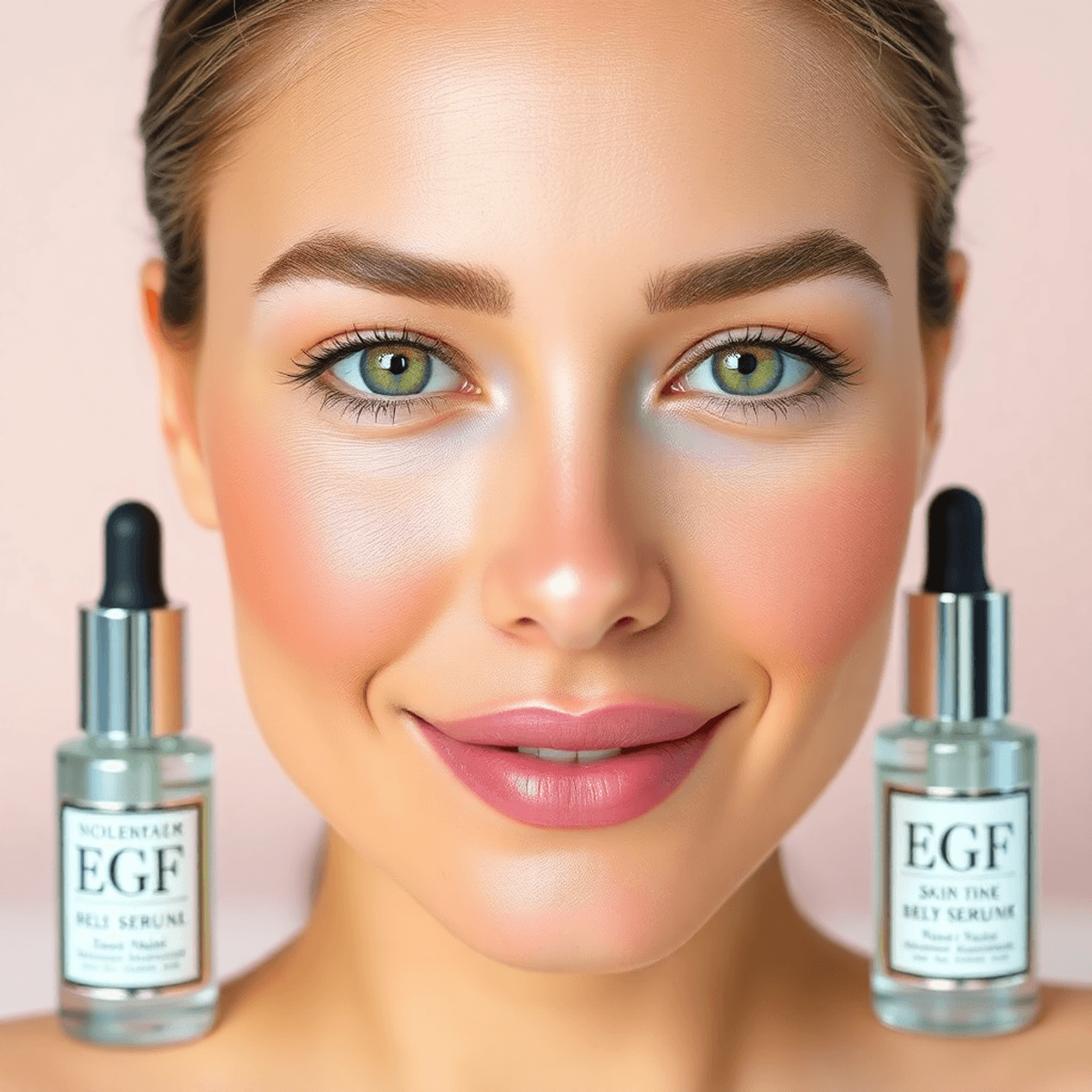
What EGF Serum Actually Does — The Science Before the Comparison
Before comparing specific products, it’s worth grounding this discussion in what EGF actually is and what the clinical evidence shows it can do.
Epidermal Growth Factor is a 6 kDa polypeptide protein that binds to EGF receptors on keratinocytes and fibroblasts, triggering cell proliferation, migration, and differentiation — the foundational processes of both wound healing and skin rejuvenation. EGF promotes increased collagen and elastin synthesis, upregulates hyaluronic acid production, reinforces the skin barrier, and demonstrates measurable anti-inflammatory properties by reducing NF-κB, IL-1α, and IL-8 expression at the cellular level. [Shin JW et al., Int Wound J, 2023 — PMC10333026]
As we age, both endogenous EGF production and EGF receptor responsiveness decline — contributing to slower cell turnover, collagen loss, and the progressive visible signs of aging. Topical EGF serum replenishes this signaling capacity from the outside in.
The clinical evidence is specific: a three-month open-label study of 29 women applying barley-derived EGF serum twice daily found statistically significant improvements in fine lines, skin texture, pore size, and dyschromatic conditions beginning within the first month — with continued improvement trends thereafter. [Schouest JM et al., J Drugs Dermatol, 2012 — PMID: 22527430] This is the foundational clinical study that established barley-derived EGF serum as a validated skincare ingredient — and it used Bioeffect EGF Serum as the study product.
How EGF Is Made — and Why the Source Matters
Not all EGF serums contain the same type of EGF, and this distinction is relevant when comparing products.
Barley-derived synthetic EGF (used by Bioeffect) is produced by inserting the human EGF gene into genetically modified barley plants, which then synthesize a human-like EGF protein. The advantage is transparency — exact concentrations can be disclosed, sourcing is consistent, and the process avoids the ethical complexity of human-derived materials. The clinical validation for barley EGF is robust. [Int J Cosmet Sci, 2021 — Eskens et al.]
Synthetic oligopeptide-1 (used by The Inkey List) is a lab-synthesized peptide that mimics EGF’s cellular signaling function. It does not have the same molecular structure as EGF but activates similar biological pathways. Clinical evidence for oligopeptide-1 specifically is less extensive than for recombinant EGF.
Human mesenchymal stem cell conditioned media (used by Bradceuticals Gold) contains not just EGF but the full biological secretome of MSCs — EGF, FGF, TGF-β, VEGF, PDGF, and HGF — in the exact ratios that human cells use to communicate. This is the most biologically complete source and the most clinically validated for skin rejuvenation. [PMC7957487]
6 Decisive Differences Between Bioeffect and The Inkey List EGF Serum
1. EGF Source and Concentration Transparency
Bioeffect uses barley-bioengineered recombinant EGF — a single, isolated, well-characterized protein at a disclosed concentration. This transparency is clinically significant: it means the product’s efficacy can be directly linked to the concentration and activity of the EGF molecule itself.
The Inkey List uses oligopeptide-1, a synthetic EGF-mimicking peptide. While effective for general skin renewal, oligopeptide-1 has less direct clinical evidence than recombinant EGF, and its concentration relative to the vitamin C in the formula means EGF is not the primary active.
Advantage: Bioeffect for EGF-specific clinical validation.
2. Formulation Complexity
Bioeffect contains only seven ingredients — EGF, water, glycerin, hyaluronic acid, and a minimal stabilizing base. This minimalism is its core design philosophy and its appeal to those with sensitive or reactive skin who need an EGF serum without the risk of ingredient interactions.
The Inkey List combines oligopeptide-1 with 15% vitamin C (ascorbic acid), sodium hyaluronate, and additional actives. This makes it a multi-function serum but also increases the potential for irritation — particularly for sensitive skin or post-procedure use, where 15% ascorbic acid is contraindicated.
Advantage: Bioeffect for sensitive skin and post-procedure use. The Inkey List for users specifically targeting brightening alongside renewal.
3. Anti-Aging vs. Brightening Focus
Bioeffect is fundamentally an anti-aging and regeneration serum. Its clinical validation shows improvements in fine lines, wrinkles, skin texture, pore size, and pigmentation — all consistent with EGF’s collagen-stimulating and cell renewal mechanisms.
The Inkey List adds a significant brightening dimension through 15% vitamin C, which neutralizes free radicals, fades hyperpigmentation, and enhances overall luminosity. For skin concerns that include both aging and uneven tone or sun damage, this dual-action approach offers more coverage in a single product.
Advantage: The Inkey List for brightening. Bioeffect for pure regeneration.
4. Post-Microneedling Compatibility
Bioeffect’s minimal, fragrance-free formula makes it compatible with post-microneedling application in theory — EGF delivered through open micro-channels does amplify its clinical impact. However, its formulation was designed for daily use, not specifically for the post-procedure window.
The Inkey List’s 15% vitamin C makes it entirely unsuitable for immediate post-microneedling application. Ascorbic acid at high concentrations causes significant irritation when absorbed through open micro-channels and should not be applied for at least 48–72 hours post-procedure.
For the post-microneedling window specifically, neither product is optimally formulated for this purpose. Bradceuticals Gold was built for exactly this application — delivering a full-spectrum mesenchymal stem cell growth factor complex, including EGF, through open micro-channels when absorption is at its highest.
Advantage: Bradceuticals Gold for post-microneedling. Bioeffect for daily use alongside a microneedling regimen.
5. Price and Accessibility
Bioeffect sits in the premium skincare tier — a positioning justified by its unique barley-derived EGF technology, minimal formulation philosophy, and the clinical research investment behind it. It is a considered purchase rather than a budget buy.
The Inkey List is deliberately accessible — one of the brand’s core commitments is offering clinically inspired ingredients at entry-level pricing. For anyone exploring EGF serums for the first time or looking for a budget-conscious option that delivers real results, The Inkey List offers a credible starting point.
Advantage: The Inkey List for accessibility. Bioeffect for premium, research-backed single-ingredient EGF.
6. Texture and Daily Wearability
Bioeffect has a lightweight formula with an initially tacky feel that dissipates quickly — working well under moisturizer and SPF without pilling or heaviness.
The Inkey List has a lightweight gel texture that absorbs quickly and leaves a matte finish, making it practical for layering under makeup. Some users with sensitive skin report stinging from the vitamin C concentration, particularly if the skin barrier is compromised.
Advantage: Tie — both work well in daily routines, with The Inkey List having a slight edge for matte finish wearers.
Which EGF Serum Should You Choose?
The honest answer depends on your primary skin goal and skincare context:
Choose Bioeffect EGF Serum if: Your focus is pure anti-aging and regeneration. You have sensitive skin. You want a minimal, fragrance-free formula with robust clinical validation. You want an EGF serum you can use daily alongside a microneedling regimen without compatibility concerns.
Choose The Inkey List 15% Vitamin C + EGF Serum if: You’re targeting both brightening and renewal. You have a budget and want clinically inspired ingredients at accessible pricing. You don’t have sensitive skin and are not in a post-procedure window.
Choose Bradceuticals Gold if: You’re doing microneedling and want the EGF serum that performs best in the post-procedure window — delivering not just EGF but a full-spectrum mesenchymal stem cell growth factor complex through open micro-channels when your skin is most receptive. No other product on this list is formulated for that specific moment.
What to Look for Beyond These Two Options
For those wanting to explore beyond Bioeffect and The Inkey List, the key variables in any EGF serum evaluation are: the source and concentration of EGF or EGF-mimicking ingredient, whether the formula includes complementary growth factors or just EGF alone, compatibility with sensitive or post-procedure skin, and clinical evidence behind the specific formulation.
The broader growth factor serum space also includes human mesenchymal stem cell conditioned media serums — which deliver not a single growth factor but the full biological secretome that cells actually use to signal regeneration. This is the category Bradceuticals Gold occupies, and the clinical evidence for MSC-derived serums in skin rejuvenation is among the strongest in the growth factor space. [Kalinina et al., PMC, 2021 — PMC7957487]
Frequently Asked Questions
Is Bioeffect EGF Serum clinically proven? Yes. The barley-derived EGF in Bioeffect was the subject of a published clinical study showing statistically significant improvements in fine lines, skin texture, pore size, and pigmentation after three months of twice-daily use in 29 women. [Schouest JM et al., J Drugs Dermatol, 2012 — PMID: 22527430]
Can I use The Inkey List Vitamin C + EGF Serum after microneedling? No — not immediately. The 15% vitamin C concentration is too irritating for post-procedure application through open micro-channels. Wait at least 48–72 hours before reintroducing vitamin C after microneedling.
Is oligopeptide-1 the same as EGF? Oligopeptide-1 is a synthetic peptide that mimics EGF’s cellular signaling function but is not structurally identical to EGF. The clinical evidence base for EGF specifically is more extensive than for oligopeptide-1.
Which EGF serum is best for microneedling? For post-microneedling application specifically, Bradceuticals Gold is the most comprehensively formulated option — combining EGF with FGF, TGF, VEGF, and PDGF from human mesenchymal stem cell conditioned media in a fragrance-free, post-procedure formula.
Can I use Bioeffect daily and Bradceuticals Gold post-microneedling? Yes — this is a rational combination. Bioeffect for consistent daily EGF delivery and barrier support; Bradceuticals Gold applied immediately post-microneedling when absorption is highest and the full growth factor complex is most impactful.
The Bottom Line
Bioeffect EGF Serum and The Inkey List 15% Vitamin C + EGF Serum are both legitimate, well-formulated products with real clinical grounding. Bioeffect wins on EGF purity, sensitivity compatibility, and regeneration focus. The Inkey List wins on brightening coverage and accessibility. Neither was designed for the post-microneedling window — and for that specific application, Bradceuticals Gold delivers what EGF serums alone cannot: the full biological growth factor complex that makes every microneedling session count.
References
- Schouest JM et al. Improved Texture and Appearance of Human Facial Skin After Daily Topical Application of Barley Produced, Synthetic, Human-like EGF Serum. J Drugs Dermatol. 2012; PMID: 22527430. https://pubmed.ncbi.nlm.nih.gov/22527430/
- Shin JW et al. The Use of Epidermal Growth Factor in Dermatological Practice. Int Wound J. 2023; PMC10333026. https://pmc.ncbi.nlm.nih.gov/articles/PMC10333026/
- Esquirol-Caussa J & Herrero-Vila E. EGF in Aesthetics and Regenerative Medicine: Systematic Review. J Clin Aesthet Sci. 2021; PMC8423211. https://pmc.ncbi.nlm.nih.gov/articles/PMC8423211/
- Eskens et al. Challenges and Effective Routes for Formulating and Delivery of EGF in Skin Care. Int J Cosmet Sci. 2021. https://onlinelibrary.wiley.com/doi/10.1111/ics.12685
- Kalinina et al. Applications of Mesenchymal Stem Cells in Skin Regeneration and Rejuvenation. PMC. 2021; PMC7957487. https://pmc.ncbi.nlm.nih.gov/articles/PMC7957487/
Disclaimer: This article is intended for informational purposes only and does not constitute medical advice. Always consult a licensed dermatologist or skincare professional before beginning any new skincare treatment.
About Bradceuticals : Thuy Myers is the founder of Bradceuticals which manufactures and distributes skin care and hair regrowth serums that use growth factors from human stem cells as the catalyst for regeneration. When she is not busy running the business and maintaining blogs, she is continuing her practice as a semiconductor engineer and occasionally teaches college engineering. In her free time, she enjoys the beach, working out at the gym and hanging out with her kiddo Brad.