

Hair follicles are not dead — they are dormant. The distinction matters clinically, because it is precisely this dormancy that a red light therapy helmet is designed to reverse. Photobiomodulation, the mechanism behind every LLLT helmet on the market, works by stimulating cytochrome c oxidase in the mitochondria of follicular cells, dissociating inhibitory nitric oxide and restoring electron transport — increasing ATP production, improving local blood flow, and shifting follicles from the telogen (resting) phase back into the anagen (active growth) phase. (PMC6737896) A meta-analysis of seven double-blind randomized controlled trials found a significant overall increase in hair density in subjects using LLLT helmet and comb devices versus sham controls, with a standardized mean difference of 1.27 — a clinically meaningful effect size. (PMC8675345) The red light therapy helmet is not a cosmetic trend. It is a device with a growing body of peer-reviewed evidence behind it.
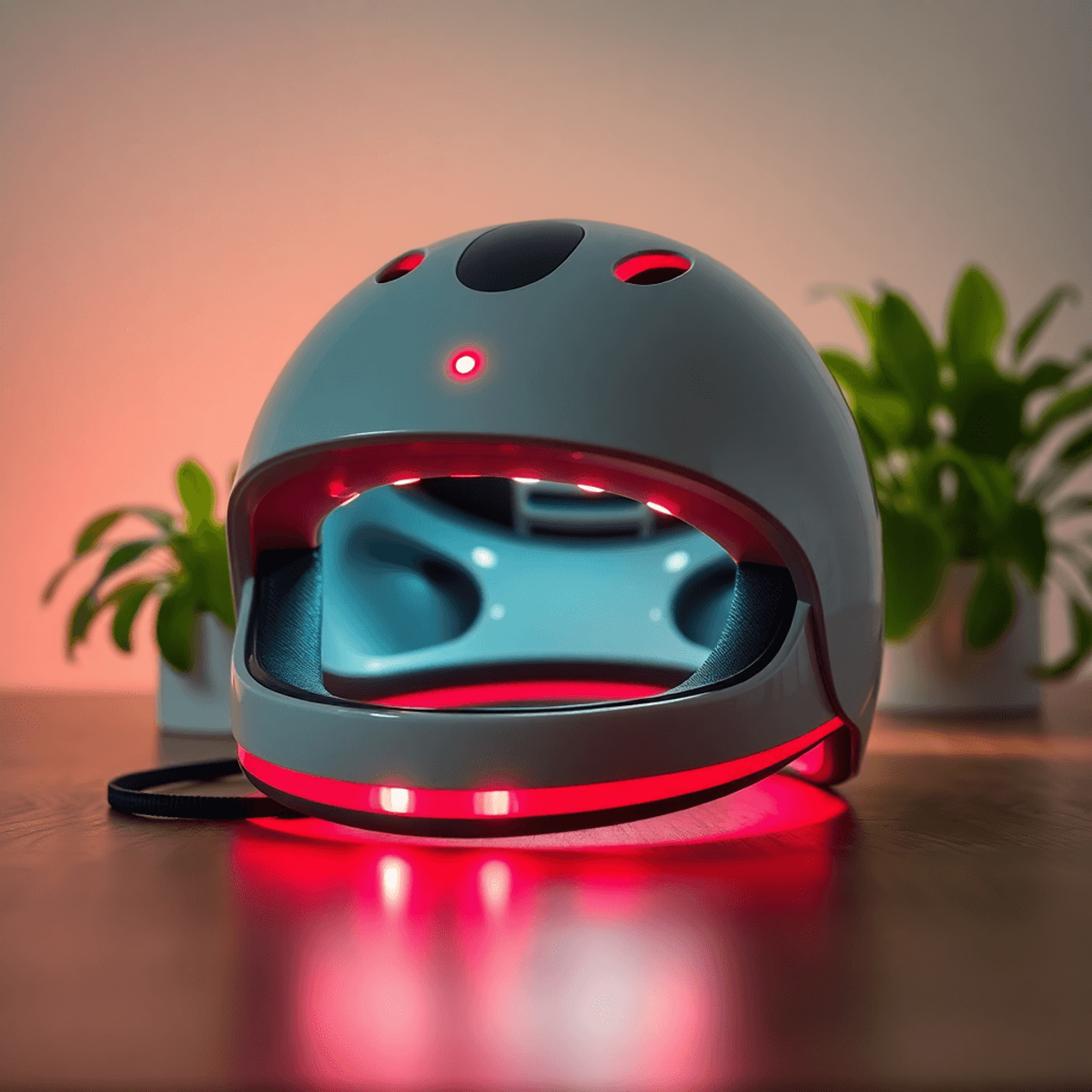
Pairing your red light therapy helmet sessions with the Bradceuticals Gold Hair Follicle and Adipose Stem Cell Serum creates a synergistic protocol that addresses hair loss from two complementary angles. The correct sequence is to apply the serum after dermarolling the scalp — to damp skin — then follow immediately with your red light therapy helmet session. The light energy and the stem cell-derived growth factors work together: LLLT reactivates the follicular environment while the serum floods it with the regenerative signals needed to sustain new growth. Used separately, each produces results. Used together as a complete protocol, the compounding effect on hair density and thickness is the point.
How a Red Light Therapy Helmet Actually Works at the Cellular Level
The mechanism behind every red light therapy helmet is photobiomodulation — a biological response to specific wavelengths of red and near-infrared light. When the red light therapy helmet emits light in the 630–700 nm range, photons are absorbed by cytochrome c oxidase (CCO), the terminal enzyme of the mitochondrial respiratory chain. This absorption dissociates inhibitory nitric oxide from CCO, restoring electron transport, increasing mitochondrial membrane potential, and elevating ATP synthesis — the cellular energy currency that drives follicular activity. (PMC5844808)
The cascade triggered by red light therapy helmet use extends well beyond ATP. Secondary effects include a brief controlled increase in reactive oxygen species, elevated nitric oxide release that promotes vasodilation and improved blood flow to the scalp, and downstream activation of transcription factors that govern cell proliferation, migration, and new protein synthesis. (PMC5523874) For hair follicles specifically, this translates to stimulation of epidermal stem cells in the follicle bulge, acceleration of anagen re-entry, and increased vascularization around the follicular unit — all of which create the conditions for measurable new hair growth. (PMC6737896)
5 Clinical Findings That Support the Red Light Therapy Helmet for Hair Regrowth
1. Randomized Controlled Trials Show Significant Hair Density Increases
The most rigorous evidence for the red light therapy helmet comes from multiple randomized, double-blind, sham-controlled trials. A 16-week RCT using a bicycle helmet-type LLLT device containing 21 laser diodes and 30 LEDs at 655 nm found a 35% increase in hair growth in male androgenetic alopecia patients compared to the sham group. (PMC3944668) A separate 24-week multicenter double-blind RCT evaluating a helmet-type device in both male and female patients with androgenetic alopecia showed statistically significant improvements in mean hair thickness (12.6 vs 3.9 in the control group) and hair density (17.2 vs −2.1 in the control group). (PMC7373546) These are not marginal effects — they reflect a meaningful biological response to consistent red light therapy helmet use.
2. The Red Light Therapy Helmet Works in Both Men and Women
A concern with many hair loss treatments is sex-specific efficacy. Clinical data for the red light therapy helmet does not support this limitation. The female arm of the TH655 randomized controlled trial — using the same 655 nm TOPHAT helmet device studied in men — demonstrated statistically significant improvement in hair growth in women with androgenetic alopecia over 16 weeks, confirming that the photobiomodulatory mechanism operates effectively regardless of sex. (PMC4265291) A review of LLLT alopecia studies similarly confirmed that helmet-type devices produced significant hair regrowth in both male and female subjects across multiple controlled trials. (PMC8906269)
3. LLLT and Minoxidil Produce Greater Results in Combination Than Either Alone
For those already using conventional treatments, the red light therapy helmet offers additive rather than competing benefit. A study comparing minoxidil alone, LLLT alone, and their combination showed that the combination group produced the highest percentage of participants with significant hair density improvement — 43.69% versus 34.94% for minoxidil alone and 34.41% for LLLT alone. (PMC8675345) Only the combination group achieved statistically significant improvement by physician assessment. The red light therapy helmet is well positioned as an enhancement to existing protocols rather than a replacement.
4. A 24-Week Trial Confirms Safety and Tolerability Alongside Efficacy
A 24-week prospective single-arm clinical trial evaluating a helmet-shaped LLLT device emitting 630–690, 820–880, and 910–970 nm wavelengths across 720 diodes found significant improvements in hair density and thickness at both 12 and 24 weeks. (PMC10564188) Adverse effects were minimal — mild headache reported in 8.2% of participants and mild itching in 4.1% — with no severe discomfort reported across the trial period. (PMC10564188) No sex difference in response was identified. This trial also confirmed no correlation between age and sebum secretion, providing reassurance across a broad demographic of red light therapy helmet users.
5. Meta-Analysis Confirms the Red Light Therapy Helmet Outperforms Sham Devices
The most statistically powerful evidence for the red light therapy helmet comes from a systematic review and meta-analysis of seven double-blinded randomized controlled trials evaluating FDA-approved LLLT devices. The analysis yielded a standardized mean difference of 1.27 in hair density improvement for LLLT versus sham — a result that held across both comb-type and helmet-type devices, and across both male and female subgroups. (PMC8675345) Egger’s test confirmed no significant publication bias. The body of evidence is consistent: the red light therapy helmet produces real, reproducible improvements in hair density in patients with pattern hair loss.
What to Look for When Choosing a Red Light Therapy Helmet
Not every red light therapy helmet is equivalent. These are the specifications that determine clinical efficacy:
Wavelength is the most important variable. Effective red light therapy helmet devices operate in the 630–700 nm range for red light and 820–880 nm for near-infrared. The 655 nm wavelength has the most RCT evidence behind it. Devices operating in the 700–780 nm range fall into a trough in the cytochrome c oxidase absorption spectrum and are considered less effective. (PMC6737896)
Diode count and coverage determines whether a red light therapy helmet can adequately treat the full vertex of the scalp. Clinically validated helmet devices in the meta-analysis used between 40 and 304 diodes. Higher diode counts generally mean more even coverage, which matters for comprehensive follicular stimulation.
Session duration and frequency in clinical trials typically range from 20 to 25 minutes every other day or three times per week. Consistent use over a minimum of 16 weeks is required to see significant results — short-term or irregular use is insufficient to produce the anagen re-entry that drives visible regrowth.
FDA clearance is a meaningful benchmark for safety and device equivalency. As of early 2020, 32 home-use LLLT devices had received FDA 510(k) clearance for pattern hair loss. (PMC8675345) Clearance does not guarantee efficacy but confirms the device meets safety standards for consumer use.
The Complete Red Light Therapy Helmet Protocol for Maximum Results
A red light therapy helmet used in isolation addresses one mechanism of hair loss — follicular dormancy driven by reduced cellular energy and poor scalp circulation. A complete protocol addresses the full picture.
Step 1 — Scalp dermarolling. Use a clean dermaroller on the scalp to create micro-channels that enhance topical absorption. This is the same transdermal delivery principle used in facial microneedling.
Step 2 — Apply the Bradceuticals Gold Hair Follicle and Adipose Stem Cell Serum. Apply the serum immediately after dermarolling to damp scalp skin — never to completely dry skin. The open micro-channels allow the stem cell-derived growth factors to reach the follicular unit directly, delivering the regenerative signaling that light therapy alone cannot provide.
Step 3 — Red light therapy helmet session. Follow immediately with 20–25 minutes under your red light therapy helmet. The photobiomodulatory effect and the growth factor serum work simultaneously — LLLT energizes the follicular mitochondria and promotes vascular support while the stem cell signals direct cellular repair and new hair growth.
Consistency across this three-step protocol over a minimum of 16 weeks is what the clinical data reflects. Isolated sessions produce modest effects; a sustained protocol produces the density and thickness improvements documented in the RCTs.
Red Light Therapy Helmet vs. Other Hair Loss Treatments
Understanding where the red light therapy helmet fits relative to the other major treatment options helps set realistic expectations:
Minoxidil is a topical vasodilator that extends the anagen phase and increases follicular size. It requires daily application and produces regrowth that reverses when use is discontinued. Combining minoxidil with a red light therapy helmet has been shown to produce superior outcomes to either treatment alone. (PMC8675345)
Finasteride blocks 5α-reductase to reduce DHT levels in the scalp and is approved for male pattern hair loss. It carries potential systemic side effects and is not approved for women. The red light therapy helmet offers a sex-neutral, systemic-effect-free alternative for patients who cannot or prefer not to use finasteride.
PRP (Platelet-Rich Plasma) injections deliver concentrated growth factors directly to the scalp via injection. The Bradceuticals Gold Hair Follicle and Adipose Stem Cell Serum combined with dermarolling provides a non-injection route to deliver stem cell-derived growth factors through the same scalp micro-channels. For patients seeking a non-invasive complement to PRP or a standalone alternative, the dermarolling-plus-serum-plus-red light protocol covers the growth factor delivery angle without needles.
For more on the science of stem cell-based hair regrowth, 10 Reasons Why Stem Cell Skin Care Is a Game Changer offers additional context on the regenerative mechanisms involved.
Frequently Asked Questions About the Red Light Therapy Helmet
How long does a red light therapy helmet take to show results? Clinical trials document significant improvements in hair density and thickness at 16 to 24 weeks of consistent use. (PMC7373546) The minimum meaningful treatment period is 16 weeks — results before this point are possible but not reliably measurable.
How often should I use my red light therapy helmet? Clinical protocols use the red light therapy helmet every other day or three times per week for 20 to 25 minutes per session. Daily use is used in some studies with no reported increase in adverse effects.
Is the red light therapy helmet safe? All RCTs reviewed report the red light therapy helmet as safe with no severe adverse effects. Minor side effects such as mild scalp itching or occasional mild headache occurred in a small minority of participants and resolved without intervention. (PMC10564188)
Does the red light therapy helmet work for women? Yes. Randomized controlled trials confirm statistically significant hair growth improvements in women with androgenetic alopecia using the same red light therapy helmet devices studied in men. (PMC4265291)
What wavelength should a red light therapy helmet use? The 655 nm wavelength has the most RCT evidence and aligns with the cytochrome c oxidase absorption peak that drives photobiomodulation. Devices combining 650–670 nm red light with 820–880 nm near-infrared offer broader follicular coverage. Wavelengths in the 700–780 nm range are less effective. (PMC6737896)
Can I combine the red light therapy helmet with other treatments? Yes — and the evidence suggests combination approaches outperform monotherapy. Combining the red light therapy helmet with the Bradceuticals dermarolling and stem cell serum protocol addresses follicular energetics, vascular support, and growth factor signaling simultaneously.
References
- Low-Level Laser (Light) Therapy (LLLT) for Treatment of Hair Loss. PMC3944668. https://pmc.ncbi.nlm.nih.gov/articles/PMC3944668/
- Low-level light therapy using a helmet-type device for androgenetic alopecia: A 16-week randomized double-blind trial. PMC7373546. https://pmc.ncbi.nlm.nih.gov/articles/PMC7373546/
- Role of Low-Level Light Therapy (LLLT) in Androgenetic Alopecia. PMC8906269. https://pmc.ncbi.nlm.nih.gov/articles/PMC8906269/
- A Systematic Review and Meta-analysis of FDA-Approved Home-use LLLT Devices for Pattern Hair Loss. PMC8675345. https://pmc.ncbi.nlm.nih.gov/articles/PMC8675345/
- Assessment of Effects of Low-Level Light Therapy on Scalp Condition and Hair Growth. PMC10564188. https://pmc.ncbi.nlm.nih.gov/articles/PMC10564188/
- The Growth of Human Scalp Hair in Females Using Visible Red Light LLLT. PMC4265291. https://pmc.ncbi.nlm.nih.gov/articles/PMC4265291/
- Photobiomodulation for the Management of Alopecia: Mechanisms, Patient Selection and Perspectives. PMC6737896. https://pmc.ncbi.nlm.nih.gov/articles/PMC6737896/
- Mechanisms and Applications of the Anti-Inflammatory Effects of Photobiomodulation. PMC5523874. https://pmc.ncbi.nlm.nih.gov/articles/PMC5523874/
- Mechanisms and Mitochondrial Redox Signaling in Photobiomodulation. PMC5844808. https://pmc.ncbi.nlm.nih.gov/articles/PMC5844808/
- The Use of Light-Based Therapies in the Treatment of Alopecia. PMC12395542. https://pmc.ncbi.nlm.nih.gov/articles/PMC12395542/
Disclaimer: This article is for educational purposes only and does not constitute medical advice. Always consult a licensed dermatologist or healthcare professional before beginning any hair loss treatment protocol. Individual results vary.
Last reviewed: March 2026
About Bradceuticals : Thuy Myers is the founder of Bradceuticals which manufactures and distributes skin care and hair regrowth serums that use growth factors from human stem cells as the catalyst for regeneration. When she is not busy running the business and maintaining blogs, she is continuing her practice as a semiconductor engineer and occasionally teaches college engineering. In her free time, she enjoys the beach, working out at the gym and hanging out with her kiddo Brad.