

You would never undergo surgery and leave the wound untreated afterward. Yet most people finish a microneedling session and apply whatever serum happens to be closest — without asking whether that product belongs on freshly compromised skin with thousands of open channels reaching into living tissue. Knowing what serums to use during microneedling is not a preference question. It is a clinical decision that determines whether those microchannels fill with biological instructions or just moisture. A randomized controlled trial confirmed that growth factors applied post-microneedling produced significant improvements after one session — while the control group needed four sessions to approach comparable outcomes (PMC7716740).
Getting what serums to use during microneedling right transforms a good procedure into an exceptional result. A dermatological review confirmed that growth factors promote fibroblast migration, increase collagen and hyaluronic acid synthesis, and activate the PI3K/AKT and ERK/MAPK repair pathways (PMC10333026). Bradceuticals Gold Mesenchymal Stem Cell Growth Factor Serum delivers human mesenchymal stem cell-derived growth factors through open microchannels — applied to damp, dewy skin immediately after treatment — answering what serums to use during microneedling with clinical-grade precision.
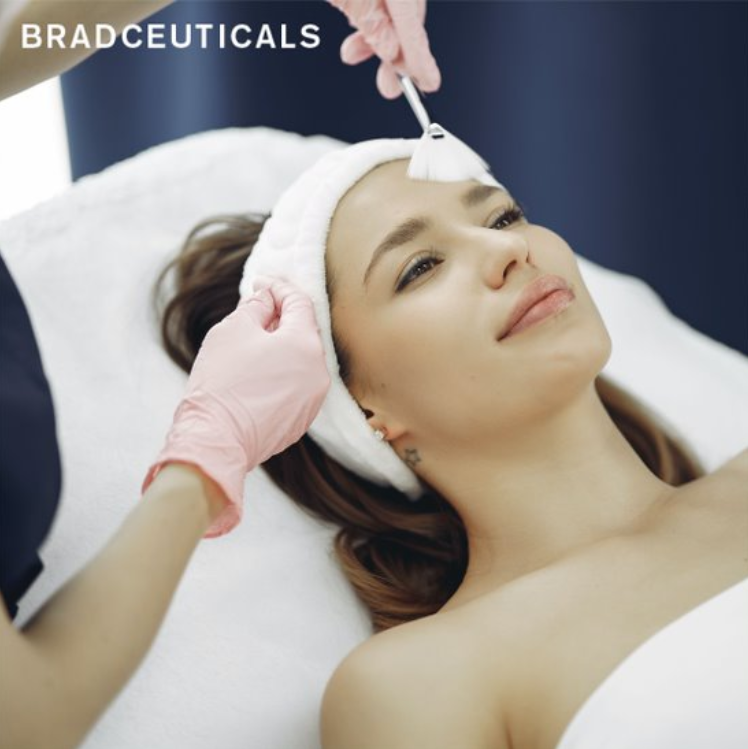
Rule 1: Growth Factor Serums Belong in the Post-Procedure Window
The first answer to what serums to use during microneedling is always growth factors. Microchannels bypass the stratum corneum — the barrier that blocks molecules above 500 daltons. Growth factor proteins exceed 15,000 daltons. This post-procedure window is the only time these large proteins can reach dermal fibroblasts directly.
A 2025 prospective RCT confirmed that even a single growth factor — PDGF alone — outperformed standard care on 6 of 7 objective parameters after microneedling (PMC12427151). A complete multi-factor secretome containing PDGF alongside EGF, FGF, TGF-beta, VEGF, and HGF delivers exponentially broader collagen-building instruction. When deciding what serums to use during microneedling, growth factors are the only category that requires microchannels to reach their target cells.
Research confirms that up to 80% of mesenchymal stem cells’ therapeutic effect occurs through the molecules they release (PMC11518787). Bradceuticals captures this complete paracrine output from human bone marrow mesenchymal stem cells — the broadest growth factor source available.
Rule 2: Hyaluronic Acid Is Supportive — Not Primary
Hyaluronic acid appears in almost every recommendation for what serums to use during microneedling. It is a legitimate supportive ingredient — it attracts moisture, soothes discomfort, and creates the hydrated environment healing skin needs. But hyaluronic acid is a humectant, not a growth factor. It cannot bind to fibroblast receptors. It cannot instruct cells to produce collagen.
At 500 daltons or less depending on molecular weight, hyaluronic acid penetrates intact skin without needing microchannels. Using only HA during the post-procedure window means filling channels designed for 15,000-dalton proteins with a molecule that absorbs perfectly well through normal skin any other day.
The correct protocol: apply a growth factor serum first to exploit the microchannel window for large-molecule delivery, then layer hyaluronic acid on top as a hydrating seal. This approach answers what serums to use during microneedling with a sequence that respects the biology — growth factor instruction first, hydration support second.
Rule 3: Eliminate Everything That Causes Harm
Knowing what serums to use during microneedling also means knowing what to exclude. Open microchannels provide direct dermal access for every ingredient applied — including irritants that would normally be blocked by the stratum corneum.
Vitamin C serums: L-ascorbic acid formulations at pH 2.5–3.5 cause stinging and inflammatory irritation in open channels. Reserve for non-treatment days.
Retinol: Causes additional barrier disruption and photosensitivity on already compromised skin. Wait at least 48 hours post-procedure.
AHAs and BHAs: Glycolic acid, salicylic acid, and lactic acid create chemical exfoliation on tissue that is already managing controlled mechanical injury. Avoid for one week.
Fragranced products: Synthetic fragrance compounds trigger inflammatory cascades that extend redness and counteract collagen signaling. What serums to use during microneedling must always be fragrance-free.
Alcohol-based serums: Ethanol dehydrates exposed dermis and denatures growth factor proteins on contact.
Rule 4: Match the Serum to the Concern
What serums to use during microneedling depends partly on the treatment goal, but growth factors address every common concern simultaneously:
Anti-aging and wrinkles: TGF-beta in growth factor serums directly commands collagen synthesis. A 24-week trial demonstrated biopsy-confirmed collagen and elastin increases with a median six-year decrease in self-perceived age (PMC9823186).
Hyperpigmentation: EGF reduces melanogenesis-associated protein expression — clinical data shows 73.4% melasma improvement (PMC8423211).
Acne scars: Growth factors instruct fibroblasts to deposit new collagen in normal lattice patterns that replace disorganized scar tissue. A comprehensive review confirmed microneedling produces a 400% increase in collagen at six months (PMC4976400).
Post-inflammatory redness: EGF inhibits IL-1alpha, IL-8, and TNF-alpha inflammatory cytokines (PMC10333026), shortening the visible recovery phase.
This is why a multi-factor growth factor serum is the single best answer to what serums to use during microneedling regardless of skin concern — it addresses collagen, pigmentation, scarring, and inflammation simultaneously.
The Complete Protocol
During treatment: Some practitioners apply a gliding serum to help the device move smoothly. If used, choose a sterile hyaluronic acid formulation — nothing with active ingredients that could irritate as needles penetrate.
Immediately post-treatment (within 5 minutes): Apply Bradceuticals Gold Mesenchymal Stem Cell Growth Factor Serum to damp skin. Press gently with clean fingertips. Pat — never rub. This is the critical step in what serums to use during microneedling that determines collagen outcomes.
5–10 minutes after serum absorption: Layer a fragrance-free hyaluronic acid serum or moisturizer to seal hydration.
First 48 hours: Continue twice-daily growth factor serum application. Mineral sunscreen with zinc oxide only. No makeup for 24 hours. No active ingredients.
Between sessions: Continue growth factor serum morning and evening. The clinical trial’s growth factor group followed this exact protocol between monthly treatments (PMC7716740). Add vitamin C in the morning and retinol in the evening on non-treatment weeks for complementary benefits.
Frequently Asked Questions
What serums to use during microneedling for beginners? A fragrance-free growth factor serum applied immediately after the procedure. Bradceuticals Gold Mesenchymal Stem Cell Growth Factor Serum is suitable for all experience levels — it supports natural healing without irritation.
What serums to use during microneedling at home? The same clinical-grade growth factor serum used in professional settings. Home dermarollers with needles under 0.5mm are validated for transdermal delivery of anti-aging products (PMC11993440). Apply the serum immediately after rolling.
What serums to use during microneedling for acne scars? Growth factor serums that deliver TGF-beta and PDGF for collagen reorganization. These growth factors instruct fibroblasts to build new collagen in organized lattice patterns that replace disorganized scar tissue over cumulative sessions.
What serums to use during microneedling if I have sensitive skin? A fragrance-free, alcohol-free growth factor serum with anti-inflammatory properties. EGF actively inhibits pro-inflammatory cytokines, making it ideal for sensitive and reactive skin types during the vulnerable post-procedure window.
Can I use multiple serums during microneedling? Apply the growth factor serum first — it needs the microchannel window for large-molecule delivery. Layer hyaluronic acid second for hydration. Do not layer active acids, retinol, or fragranced products on freshly needled skin.
References
- Merati M, et al. An Assessment of Microneedling with Topical Growth Factors. J Clin Aesthet Dermatol. 2020;13(11):22-27. (PMC7716740)
- Shin SH, et al. The use of epidermal growth factor in dermatological practice. Int Wound J. 2023;20(6):2414-2423. (PMC10333026)
- Lynch SE, et al. Recombinant Pure PDGF Improves Aesthetic Results Following RF Microneedling. J Cosmet Dermatol. 2025;24(9):e70425. (PMC12427151)
- Taub A. Regenerative topical skincare: stem cells and exosomes. Front Med. 2024;11:1443963. (PMC11518787)
- Naughton GK, et al. Targeting Multiple Hallmarks of Skin Aging. Dermatol Ther. 2023;13(1):169-186. (PMC9823186)
- Miller-Kobisher B, et al. Epidermal Growth Factor in Aesthetics and Regenerative Medicine. J Cutan Aesthet Surg. 2021;14(2):137-146. (PMC8423211)
- Singh A, Yadav S. Microneedling: Advances and widening horizons. Indian Dermatol Online J. 2016;7(4):244-254. (PMC4976400)
- Tehrani L, et al. Physiological Mechanisms and Therapeutic Applications of Microneedling. Cureus. 2025;17(3):e80510. (PMC11993440)
Disclaimer: This article is for informational purposes only and does not constitute medical advice. Consult a qualified dermatologist or licensed aesthetician before beginning any microneedling protocol. Individual results may vary.
Last Reviewed: April 2026
About Bradceuticals : Thuy Myers is the founder of Bradceuticals which manufactures and distributes skin care and hair regrowth serums that use growth factors from human stem cells as the catalyst for regeneration. When she is not busy running the business and maintaining blogs, she is continuing her practice as a semiconductor engineer and occasionally teaches college engineering. In her free time, she enjoys visiting the beach with her MUCH better half, working out at the gym, and hanging out with her kiddo.