

Your peptide serum for face is working. It is not a scam. Peptides are genuine active ingredients that signal collagen production through a clever biological mechanism — they mimic collagen fragments to trick your fibroblasts into thinking collagen is breaking down and needs replacement. The science is real and the results are measurable. But here is what your peptide serum for face cannot tell you: there is a category above peptides that does not mimic or trick or signal indirectly. It COMMANDS. A comprehensive review of 23 studies confirmed MSC conditioned media successfully reduces skin aging at every evidence level (PMC11416772).
Peptides knock on the door. Growth factors walk in and give direct orders. A 2021 study confirmed bone marrow MSC conditioned media produces significantly higher collagen AND elastin production compared to controls — through direct receptor binding on fibroblast surfaces, not indirect fragment mimicry (PMC7904527). Your peptide serum for face is the good option. Bradceuticals Gold Mesenchymal Stem Cell Growth Factor Serum is the category peptides are trying to imitate — the complete bone marrow MSC secretome delivering direct instruction through EGF, FGF, TGF-beta, VEGF, PDGF, and HGF. Here is why understanding the hierarchy changes your results.
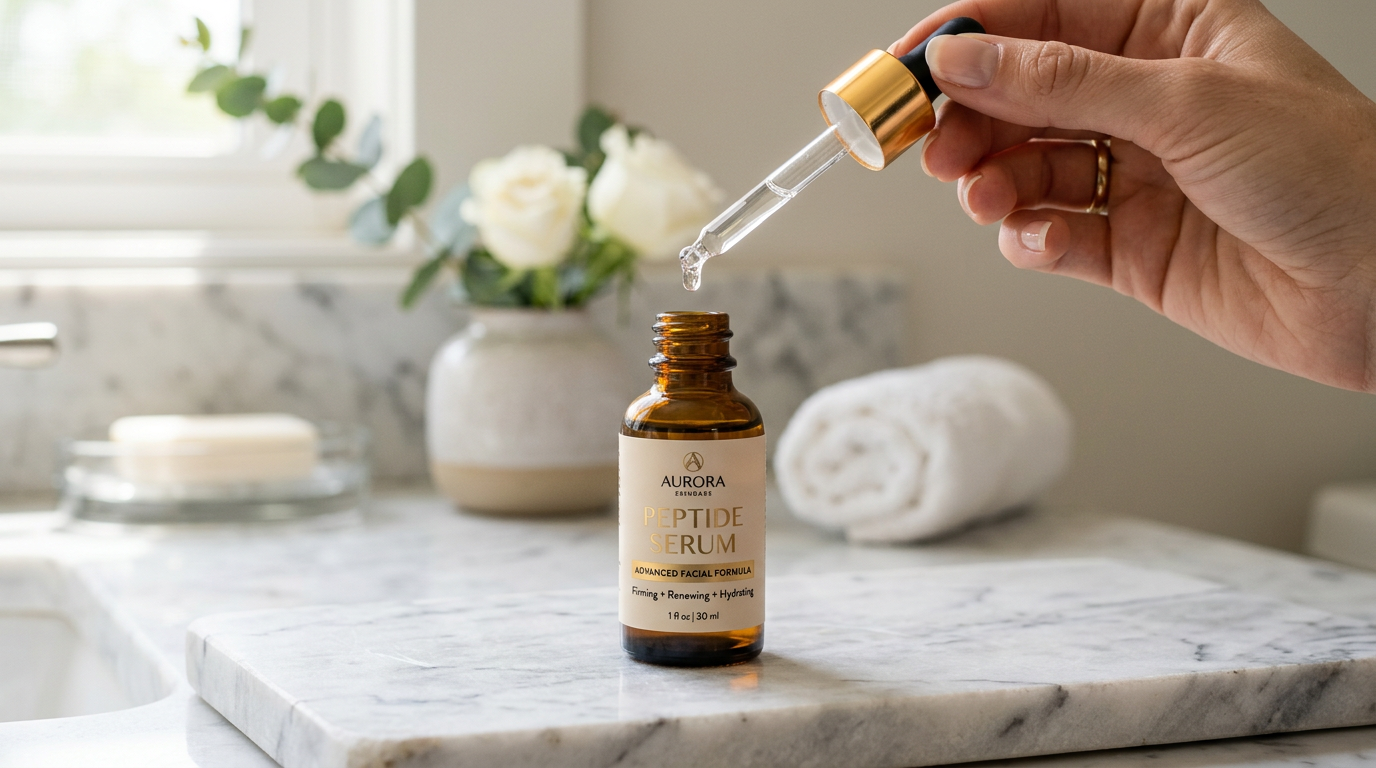
Fact 1: Your Peptide Serum for Face Mimics — Growth Factors Instruct
Peptides are short chains of amino acids — fragments of larger proteins like collagen. When your peptide serum for face delivers these fragments to your skin, fibroblasts detect them and interpret their presence as a signal: collagen must be breaking down, we need to produce more. Clever. Indirect. Dependent on the fibroblast interpreting the signal correctly.
Growth factors skip the interpretation. EGF binds to EGFR receptors. FGF binds to FGFR receptors. TGF-beta binds to TGF-beta receptors. Each binding event activates intracellular PI3K/AKT and ERK/MAPK pathways that COMMAND collagen and elastin synthesis (PMC10333026). No mimicry. No interpretation. Direct instruction through specific receptor binding.
Your peptide serum for face sends a suggestion. Bradceuticals sends a command.
Fact 2: Your Peptide Serum for Face Addresses One Problem — Growth Factors Address Three
Most peptide serum for face products stimulate collagen production indirectly. That addresses one of three aging problems. Growth factors address all three simultaneously:
Problem 1 — Collagen decline: Growth factors command collagen synthesis directly through receptor binding.
Problem 2 — Elastin degradation: The same secretome instructs elastin production — the protein responsible for skin firmness and bounce-back that peptides rarely target.
Problem 3 — MMP destruction: EGF inhibits inflammatory cytokines IL-1alpha, IL-8, and TNF-alpha (PMC10333026). MSC exosomes restore TIMP-1 and inhibit MMP-1 through -9 (PMC12395928). Building collagen while MMP enzymes destroy existing collagen produces zero net gain. No peptide serum for face inhibits MMP enzymes. The complete secretome does.
Fact 3: Your Peptide Serum for Face and Growth Factors Work Beautifully Together
This is not an either-or choice. Peptides and growth factors complement each other through different mechanisms targeting the same outcome. Your peptide serum for face provides indirect stimulation through fragment mimicry. Growth factors provide direct instruction through receptor binding. Using both creates redundant collagen signaling from two pathways simultaneously.
Morning: Bradceuticals Growth Factor Serum on damp skin → your peptide serum for face layered over → Cosmedica HA Serum → CeraVe Moisturizing Cream → mineral sunscreen SPF 30+
Growth factors go on first because they need direct receptor contact. Peptides layer beautifully over them. Together they produce more collagen signaling than either alone.
Fact 4: Results From the Upgrade Are Structural and Lasting
Visible improvement confirmed from conditioned media applied twice daily for just 4 weeks (PMC6002314). Biopsy-confirmed collagen, elastin, AND decorin increases at 24 weeks. Participants perceived themselves six years younger (PMC9823186). A 2026 systematic review of 19 human studies confirmed exosome-based therapies improved wrinkles, elasticity, hydration, pores, AND overall appearance (PMC12933354). An RCT confirmed elasticity increased +11.3% vs -3.3% in controls (p=0.002) (MDPI 2025).
New collagen persists five to seven years (PMC11993440). Not temporary improvement. Structural change verified under a microscope. Your peptide serum for face delivers good results. Adding growth factors delivers results that last years.
Fact 5: Microneedling Amplifies Both Peptides AND Growth Factors
Growth factor proteins exceed 15,000 daltons — intact skin limits optimal penetration. Monthly microneedling creates channels that bypass the barrier entirely. A randomized controlled trial confirmed one session with growth factors matched four without (PMC7716740).
Your peptide serum for face also penetrates more effectively through microneedling channels. But growth factors benefit MORE because their larger molecular weight makes channels essential rather than optional. Good daily. Transformative through channels.
The Upgraded Peptide Serum for Face Routine
Morning: Cleanse → Bradceuticals Growth Factor Serum on damp skin → your favorite peptide serum for face → Cosmedica HA Serum → CeraVe Moisturizing Cream → mineral sunscreen SPF 30+
Evening: Cleanse → Bradceuticals Growth Factor Serum on damp skin → peptide serum → The Ordinary Niacinamide 10% + Zinc 1% → CeraVe Moisturizing Cream
Monthly (optional amplification): Microneedling with Dp Dermaceuticals HYLA ACTIVE for glide during → Bradceuticals immediately after on damp skin
Essential: Patch test before first use. Apply behind the ear. Wait 24-48 hours.
Frequently Asked Questions
Is a peptide serum for face still worth using with growth factors? Yes — peptides complement growth factors by providing indirect signaling through a different pathway. Using both creates redundant collagen stimulation. Keep your peptide serum and add growth factors underneath.
Which goes first — peptide serum for face or growth factor serum? Growth factors first on damp skin. Peptides layered over. Growth factors need direct receptor contact. Peptides work through fragment detection that does not require direct contact.
Is a peptide serum for face better than retinol? Peptides are gentler than retinol with no inflammatory side effects. Growth factors are gentler still — EGF actively inhibits inflammation. For sensitive skin, growth factors are the gentlest active with the most direct collagen instruction.
How long before upgrading from peptide serum for face shows results? Adding growth factors to your existing peptide routine shows visible improvement at 4 weeks. Structural collagen confirmed at 24 weeks. The upgrade compounds monthly.
References
- Comprehensive Review of Stem Cell CM for Anti-Aging on Skin. Stem Cells Transl Med. 2024. (PMC11416772)
- Kim SN, et al. Effects of Human BM-MSC-CM on Skin Rejuvenation. Int J Stem Cells. 2021;14(1):94-102. (PMC7904527)
- Shin SH, et al. The use of epidermal growth factor in dermatological practice. Int Wound J. 2023;20(6):2414-2423. (PMC10333026)
- Gui Q, et al. Extracellular vesicles derived from MSCs to treat skin aging. Precis Clin Med. 2024;7(1):pbae004. (PMC12395928)
- Kim YJ, et al. Anti-aging Properties of EPC-CM. Dermatol Ther (Heidelb). 2018;8(2):261-273. (PMC6002314)
- Naughton GK, et al. Targeting Multiple Hallmarks of Skin Aging. Dermatol Ther. 2023;13(1):169-186. (PMC9823186)
- Flores Rodríguez JC, et al. Efficacy of Exosome-Based Therapies for Skin Rejuvenation. Cureus. 2026;18(2):e104182. (PMC12933354)
- MSC-Exosome Therapies for Scars, Aging, Hyperpigmentation. Biomedicines. 2025;8(4):268. (MDPI 2025)
- Tehrani L, et al. Physiological Mechanisms and Therapeutic Applications of Microneedling. Cureus. 2025;17(3):e80510. (PMC11993440)
- Merati M, et al. An Assessment of Microneedling with Topical Growth Factors. J Clin Aesthet Dermatol. 2020;13(11):22-27. (PMC7716740)
Disclaimer: This article is for informational purposes only and does not constitute medical advice. The products discussed are cosmetic products and are not intended to diagnose, treat, cure, or prevent any disease. Individuals with any active skin condition, pre-existing medical condition, or those currently under the care of a physician or specialist should consult their healthcare provider before beginning any new skincare regimen. Always perform a patch test before using any new skincare product. Consult a qualified healthcare provider before beginning any microneedling protocol. Individual results may vary.
Last Reviewed: April 2026